
Unreal Engine is Epic Games' real-time 3D engine. In real estate it is used to build a photoreal model of a residential complex: the buyer walks through a courtyard that does not exist yet, picks an apartment and looks at it in morning and evening light. For a developer that means one model for the sales office, the ads and the website, and for a project that only needs two banner renders it is money you do not need to spend.
Key takeaways:
- In real time nobody picks the frame in advance: the buyer drives the camera and looks at the building, floor and apartment they care about.
- Lumen calculates light and reflections instantly, Nanite shows very detailed models without simplifying them. Buyers do not know these words, but they can see that the evening courtyard looks real.
- One model works in several places: a touch screen in the sales office, videos and stills for Instagram and ads, a browser version for the website.
- To start you need the master plan, floor plans, the facade design and the apartment list. Revit, SketchUp, 3ds Max or Archicad files speed things up.
- The numbers on 3D tours and sales come from the US resale market. For an off-plan project you will have to measure the effect in your own sales office.
- If your project is small and sells fast, or you only need two renders, this is overkill.
What does real time mean for a buyer?
A normal render is one frame. The visualiser chose the camera position, the time of day and the angle, and the buyer sees only what is in that frame. Yet the first question in a sales office is usually about something outside it: "What will I see from my window?"
In a real-time model the image is redrawn constantly, so the buyer decides where to look. At the sales desk that turns into three actions.
Walk
The buyer flies over the complex, then drops into the courtyard: the entrance, the roads, the parking, the streets next door. Within a minute or two they understand where the project sits and how it is laid out. With a brochure, the sales manager usually ends up sketching that on a sheet of paper.
Pick
An apartment picker runs inside the model: filters by building, rooms, area, floor and status. The chosen apartment lights up on the facade with a white frame and its floor plan opens next to it. When the buyer says "this one", you are both looking at the same window.
Change the light
The sun is set to the site's real coordinates. Unreal Engine's Sun Position Calculator works out the sun's position from latitude, longitude, time zone, date and time, and it can be driven from a slider inside the app (Epic Games). The buyer switches between morning, day and evening with one tap and sees for themselves when the sun reaches the apartment.

The courtyard from the top of this article, now in evening light. Same Unreal Engine 5 model, real time.
Lumen and Nanite in plain words
These two words appear in every article about Unreal Engine 5. For a developer, they mean something simple.
Lumen calculates bounced light and reflections in real time (Epic Games documentation). As the sun drops, shadows in the courtyard get longer, the glass reflects the sky, and light bounces from the facade to the ground and back. Nobody has to wait hours for a render to see it: the model responds as soon as the buyer changes the light.
Nanite is there to show very dense, detailed geometry. Railings, window frames and facade cladding do not look simplified even up close, and edges do not turn blocky as the buyer moves in on the facade.
The technical side is the studio's job. A developer can check two things without any technical knowledge: does the courtyard look convincing in evening light, and does the detail hold when you get close to the facade. At the time of writing the latest version was Unreal Engine 5.8, released in June 2026 (release notes).
What a developer gets: one model, four jobs
A model built once shows the same complex at every point of sale. The buyer sees the same courtyard in the sales office as in the ad, and finds the apartment they looked at on the website on the sales manager's screen.
| Where it runs | What the buyer sees | Who uses it |
|---|---|---|
| Sales office, exhibition, presentation | The whole complex on a large touch screen, apartment picker, courtyard tour | The sales manager together with the buyer |
| Instagram and ads | Video tours and stills rendered from the same model | Marketing team |
| Website | A browser version with the apartment picker | The buyer, alone, at home |
| CRM and Meta | The enquiry arrives with the apartment number and the ad source | Head of sales, ads team |
Sales office
The screen becomes the centre of the sales conversation: first the site and the view, then the building, then the apartment. We have written out that sequence, and what the sales manager says at the screen, step by step in the article on the sales office touch screen.
Ads and Instagram
Video tours and stills come out of the same model. Unreal's Movie Render Queue and Movie Render Graph are the high-quality render path for stills and films (Epic Games).
Instagram's ad reach in Azerbaijan is estimated at 4.25 million people, or 40.8% of the population (DataReportal, Digital 2026). That is an estimate of the ad audience, not a count of active users. It still shows where buyers first see a project, so the courtyard in the ad should be the courtyard of the model in the office.
Website
The browser version lets buyers choose a building and an apartment from home. How the apartment picker, the 3D tour and the CRM fit together on a website is covered in our article on a residential complex website.
CRM and Meta
An enquiry from the website lands in the CRM with the apartment number and the ad source. We then send Meta, through the Conversions API, which clicks turned into real buyers, and the ads learn from that who to show up for. There is a separate article on CAPI and Meta's recent changes.
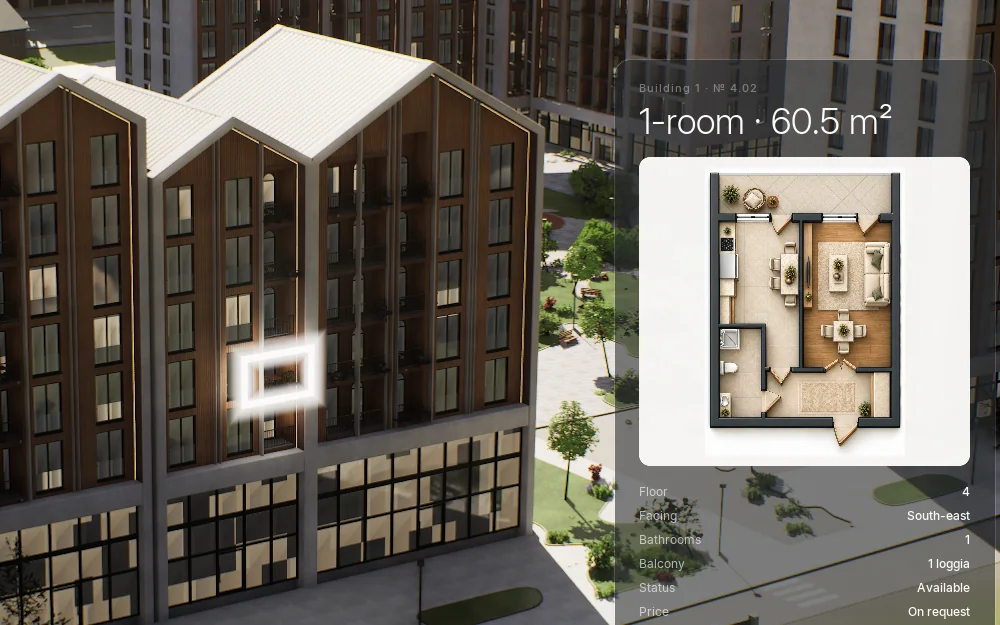
The apartment picker inside the model: filters, a list and the apartment outlined in white on the facade. Unreal Engine 5, real time.
Do 3D tours speed up sales? What the numbers say
The honest answer: there is research, but all of it comes from the US resale market, and none of it measures an off-plan project.
- The US National Association of Realtors (NAR) reported in 2021 that 67% of buyers want floor plans in a listing and 58% want virtual tours (NAR).
- Zillow reported in 2024 that its Showcase listings, which include 3D tours and interactive floor plans, were 20% more likely to get an accepted offer within 14 days and sold for 2% more (Zillow). That is a bundle, so the effect of the 3D tour alone was not isolated.
- A Texas Tech study published on Matterport's blog looked at 143,575 listings: homes with a 3D tour sold for up to 9% more, and in the South market only, up to 31% faster (Matterport). The source is the blog of a company that sells 3D tours.
We found no independent study of how a 3D model and an apartment picker affect sales speed in an off-plan building, only vendors' own case studies. So we suggest measuring it in your own office: time from first visit to reservation, and the number of visits per signed contract. Those metrics are in a table in the touch screen article.
What does the model need, and who builds it?
Four things are enough to start:
- The master plan.
- Floor plans.
- Facade renders or drawings.
- The apartment list: number, building, floor, rooms, area, status.
If you have Revit, SketchUp, 3ds Max or Archicad files, the work goes faster. Unreal's Datasmith imports from SketchUp Pro, 3ds Max, Revit, Navisworks, Rhino, Archicad and Solidworks, and in Revit 2024 and later the exporter ships inside Revit (Epic Games). We have also built a project without any CAD files, from the architect's 1:500 master plan and the developer's renders.
This is not a one-visualiser job. The team needs 3D artists for the buildings, facades and landscape, an Unreal programmer for the apartment picker and the interface, someone who connects the sales sheet or CRM to the model, and a marketing team that turns the model into ad material.
The licence side is simple. Unreal Engine is free for individuals and companies with under $1 million in annual gross revenue; above that, non-game commercial work needs an Unreal Subscription at $1,850 per seat per year (Epic Games, licence). Epic lists configurators such as apartment pickers, and interactive architectural walkthroughs, among the uses covered without royalties (Epic Games blog). Who pays, and what that means when you order one, is in our article on the Unreal Engine licence.
In Baku, Advertol builds 3D Master Plans for developers in Unreal Engine 5: a photoreal model of the complex, an apartment picker inside it, a courtyard and amenities tour, a sales office app, videos and stills for ads and a web version for the site. That is how we built our demo project of 12 buildings and 410 apartments. The model is priced on the project's size and paid once, with no monthly subscription. You can read what is inside in what a 3D master plan is, and we can talk about whether it fits your project in a 15-minute call.
When is Unreal Engine overkill?
Not every project needs a real-time model, and it is better to say so up front.
- You need two renders. A few images for a banner and a brochure are faster to get from a visualisation studio. Which format sells at which stage is covered in our article on architectural visualisation.
- There are few apartments and they sell fast. For a single building with a handful of apartments, an app with a picker is usually more than you need.
- The sales team will not use the model. Without a sales script, a model spinning on a screen is just decoration.
- You want the cheapest option. A real-time model takes far more work than a render package, and there is no point hiding that.
For an architect's presentation, Lumion or Twinmotion may be enough. The Lumion, Twinmotion and Unreal Engine comparison shows the difference in a table.
What we look at in the call
In a 15-minute online call we do three things. We look at the master plan, the renders and the sales plan: what is ready and what is missing. Then we say which parts you need: the sales office app, video, the web version, the CRM. You may not need all of them, and we will say so.
After the call the plan and the price arrive in writing, and the decision is yours. If you have a master plan, bring it. You can pick a time on the 3D Master Plan meeting page or call +994 10 335 03 35.
Frequently asked questions
Is Unreal Engine free for a real estate project?
It is free for a company with under $1 million in annual gross revenue. Above that, non-game commercial work needs a subscription at $1,850 per seat per year. Epic lists interactive architectural walkthroughs and product configurators among the uses covered without royalties.
Construction has not started yet. Can we build the model now?
Yes, and this is when it helps most: buyers see the complex before the sales office opens. The master plan, floor plans and facade design are enough. If the drawings are not ready, we can start from sketches and renders.
How is Unreal Engine different from Lumion and Twinmotion?
Lumion and Twinmotion give architects fast presentation visuals, but offer little room for custom interactivity. In Unreal Engine you build your own app: an apartment picker, a touch screen, streaming to a browser. This split is based on our own experience; there is a detailed comparison in a separate article.
Does the 3D model open on a phone?
There are two routes for phones: videos and stills from the same model for ads and Instagram, and a light browser version for the website. The full-quality app runs on the sales office screen.
Which files do you need to build the model?
The master plan, floor plans, facade renders or drawings, and the apartment list (number, area, rooms). Revit, SketchUp, 3ds Max or Archicad files speed things up. Without CAD, a model can still be built from the architect's 1:500 master plan and renders.