
Lumion and Twinmotion are for getting presentation visuals, stills and video, out of an architect's model quickly. Unreal Engine is an engine you build your own app on: an apartment picker, a touch screen in the sales office, streaming to a browser. A developer should start from the job: for design reviews and a brochure the first two are enough; for a sales tool where buyers choose their own apartment, you need Unreal Engine.
Key takeaways:
- All three tools render in real time. The difference is who they are built for and which job they do.
- Lumion and Twinmotion give architects good-looking presentation visuals fast, but offer little room for custom interactivity.
- In Unreal Engine you build the apartment picker, filters, statuses linked to the sales sheet and a touch screen app. That takes a programmer.
- Twinmotion and Unreal Engine are free for companies with under $1 million in annual revenue; above that, each has its own yearly subscription (Epic Games).
- For photoreal stills and films, V-Ray and Corona are still the most used render engines (CGarchitect survey).
- A developer often ends up with two tools: the architect's tool during design and an Unreal model for sales.
Three tools, two different jobs
A developer expects two separate things from visualisation. The first is the architect's job: showing the design to the client and the approving bodies, comparing facade and courtyard options, producing the first renders. Speed matters here, because the design keeps changing.
The second is the sales job. The buyer has to understand the complex, choose a building and an apartment, and see what is outside the window and when the sun comes in. Here the model has to be linked to the sales sheet and work as a tool in the sales manager's hands.
This is how we split it: V-Ray and Corona produce stills and films; Lumion, Twinmotion, D5 and Enscape give fast real-time presentation visuals with little custom interactivity. Unreal Engine is the choice when you need your own app: an apartment picker, a touch table, browser streaming. This split comes from our own work.
The comparison table
The licence data in the table was checked on Epic Games' pages on 6 November 2026. We do not quote Lumion's prices here; check them on the vendor's own website.
| Lumion | Twinmotion | Unreal Engine | |
|---|---|---|---|
| Render type | Real time | Real time | Real time, plus Movie Render Queue for stills and films |
| Main job | Architect's presentation visuals | Architect's presentation visuals | Your own app: apartment picker, touch screen, browser streaming |
| Custom interactivity | Little | Little | Full: interface, filters, sales sheet and CRM links are programmed |
| Who works in it | Architect, visualiser | Architect, visualiser | 3D artist and Unreal programmer |
| Who uses the result | Architect, client | Architect, client | Buyer and sales manager |
| Licence | Check the vendor's website | Free under $1M revenue, above that $445 per seat per year (January 2026) | Free under $1M revenue, above that $1,850 per seat per year |
The Twinmotion price comes from the official page as archived in January 2026 (Twinmotion licence, archive). Epic says that from 27 May 2026 Unreal Subscriptions no longer include Twinmotion and RealityScan (Epic Games). Check the current Twinmotion price on Epic's live page.
What do Lumion and Twinmotion do well?
These tools fit an architect's daily work. The architect opens their own model, sets materials, trees and light, and quickly gets a still or a video fit for a presentation. During design, when facade options are being discussed, or in a meeting with an investor or an approving body, that speed is a real help.
Twinmotion is free for companies with under $1 million in revenue, which makes it easy for a small practice to start. In the CGarchitect 2024/25 survey, Lumion and Unreal are among the tools whose use is growing (Chaos, CGarchitect survey).
The limit is interactivity. If you want the buyer to set filters and pick an apartment, see it light up on the facade, and have its status come from the sales sheet, these tools give you little room to write your own logic. Their strength is presentation.
When do you need Unreal Engine?
You need Unreal Engine when the buyer will use the model themselves. That is usually close to the sales launch: the sales office opens, the website is being built, the ads start.
What you can build in Unreal:
- An apartment picker. Filters by building, rooms, area, floor and status. The chosen apartment lights up on the facade with a white frame and its floor plan card opens.
- The real sun. The Sun Position Calculator works out the sun's position from latitude, longitude, date and time, and it can be driven from a slider inside the app (Epic Games).
- Browser streaming. Pixel Streaming runs the app on a GPU server and streams the picture to a browser (Epic Games). The server is a separate cost.
- Video from the same model. Movie Render Queue and Movie Render Graph render stills and films for ads from the same project (Epic Games).
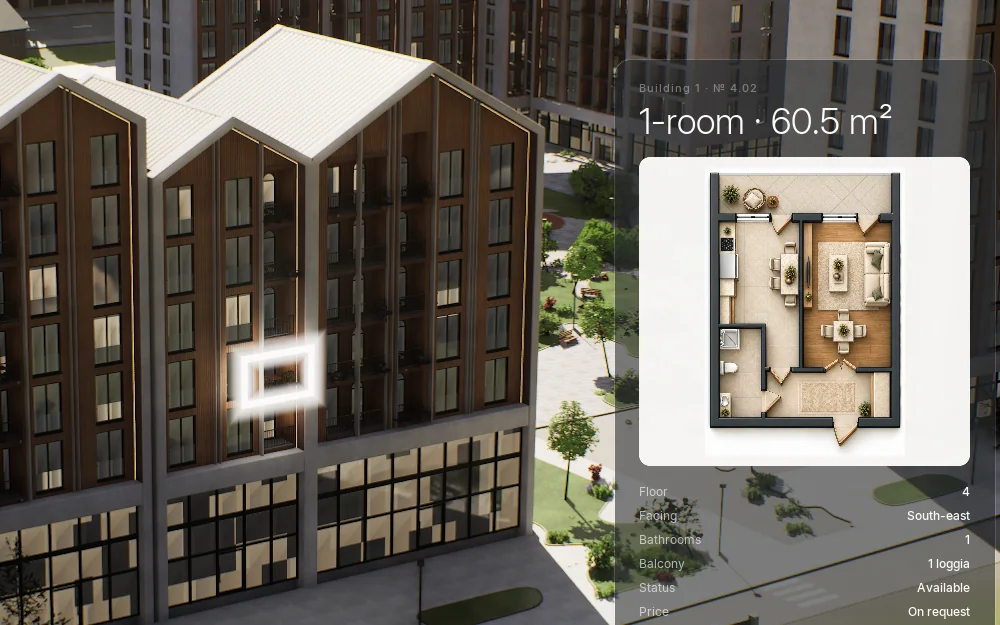
An apartment picker built in Unreal Engine 5: filters, a list and the apartment highlighted on the facade. Real time.
The price is the amount of work. Building an app in Unreal takes a programmer as well as a 3D artist, and the model also has to be connected to the sales sheet or the CRM. What a real-time model gives a buyer is covered in detail in Unreal Engine for real estate.
In Baku, Advertol builds 3D Master Plans for developers in Unreal Engine 5: a photoreal model of the complex, an apartment picker inside it, a courtyard tour, a sales office app, video for ads and a web version for the site. We can work out together what your project needs in a short call, and sometimes the answer is "Lumion is enough for now".
D5, Enscape, V-Ray and Corona in one line each
These names also come up when proposals reach a developer. In short:
- V-Ray: an offline renderer for stills and films; in the CGarchitect survey it is, together with Corona, among the most used.
- Corona: the same job, offline rendering of high-quality photoreal stills and films.
- D5: like Lumion and Twinmotion, fast real-time presentation visuals with little custom interactivity.
- Enscape: a fast real-time presentation tool for architects, with little custom interactivity.
According to the same survey, Chaos Vantage is also gaining, and 56% of respondents use AI tools in their work. The takeaway for a developer is simple: the tool a studio picks matters less than the result it hands over to you.
What should a developer order, stage by stage?
What you need from visualisation changes as the project moves from stage to stage. This table is our recommendation.
| Stage | What you need | Suitable tool |
|---|---|---|
| Concept, design | Architect's presentation, comparing options | Lumion, Twinmotion, D5, Enscape |
| Before sales | Brochure, banner, first ad images | V-Ray, Corona or stills from the Unreal model |
| Sales launch | Sales office screen, website, ad videos | Unreal Engine model and apartment picker |
| Under construction | Status updates, new ad material | The same Unreal model |
The architect's work is not wasted. The Unreal model is usually built from their CAD file (Revit, SketchUp, Archicad), and the architect's renders serve as the reference for materials and colour. So working in Lumion or Twinmotion during design does not stop you moving to Unreal for sales.
There is also a common mistake: putting the architect's presentation video on the sales office screen shortly before launch. The video looks good, but when the buyer touches the screen nothing changes, and the sales manager goes back to the brochure. The screen should answer the buyer's question.
Images made before sales should match the Unreal model later. If the buyer sees one facade in the ad and another in the office, trust goes. Which format sells when is covered in what architectural visualisation is, and the launch itself in our 90-day sales plan.
Six questions to ask a studio
Even if the contract names the tool, what you care about is the result. When you get a proposal, ask:
- Will the buyer be able to pick an apartment inside the model themselves?
- Which sheet do statuses and prices come from, and who updates them?
- Where will the model run: on the sales office screen, on the website, or only in video?
- Will the ad stills and videos come from the same model?
- Whose name is the licence in, and is the subscription included in the price? There is more on this in our article on the Unreal Engine licence.
- Who keeps the source files once the project is finished?
A studio that answers these clearly is easy to work with. If you want the answers for your own project, in a 3D Master Plan call we will look at your master plan and tell you which tool is enough.
Frequently asked questions
What is Twinmotion?
Twinmotion is Epic Games' real-time visualisation tool. Architects use it to get presentation stills and videos out of their own model quickly. It is free for companies with under $1 million in annual revenue.
Lumion or Twinmotion: which is better?
For a developer both do the same job: fast visuals for the architect's presentation. The choice usually comes down to which tool your architect already uses. If you need a sales app where buyers choose their own apartment, Unreal Engine is the tool for that job.
Is Twinmotion free?
It is free for companies with under $1 million in annual gross revenue. Above that, according to the official page as of January 2026, it costs $445 per seat per year. From 27 May 2026 Twinmotion is not included in the Unreal Subscription; check the current price on Epic's page.
Can a Revit or SketchUp model be moved into Unreal Engine?
Yes. Epic's Datasmith imports from SketchUp Pro, 3ds Max, Revit, Navisworks, Rhino, Archicad and Solidworks. In Revit 2024 and later the exporter ships inside Revit (Epic Games).
Is Unreal Engine harder than Lumion?
The difficulty starts when you build an app: an apartment picker, filters and a CRM link all need programming. That is why an Unreal project is usually a 3D artist and a programmer working together. For an architect's day-to-day presentations, Lumion or Twinmotion is more convenient.