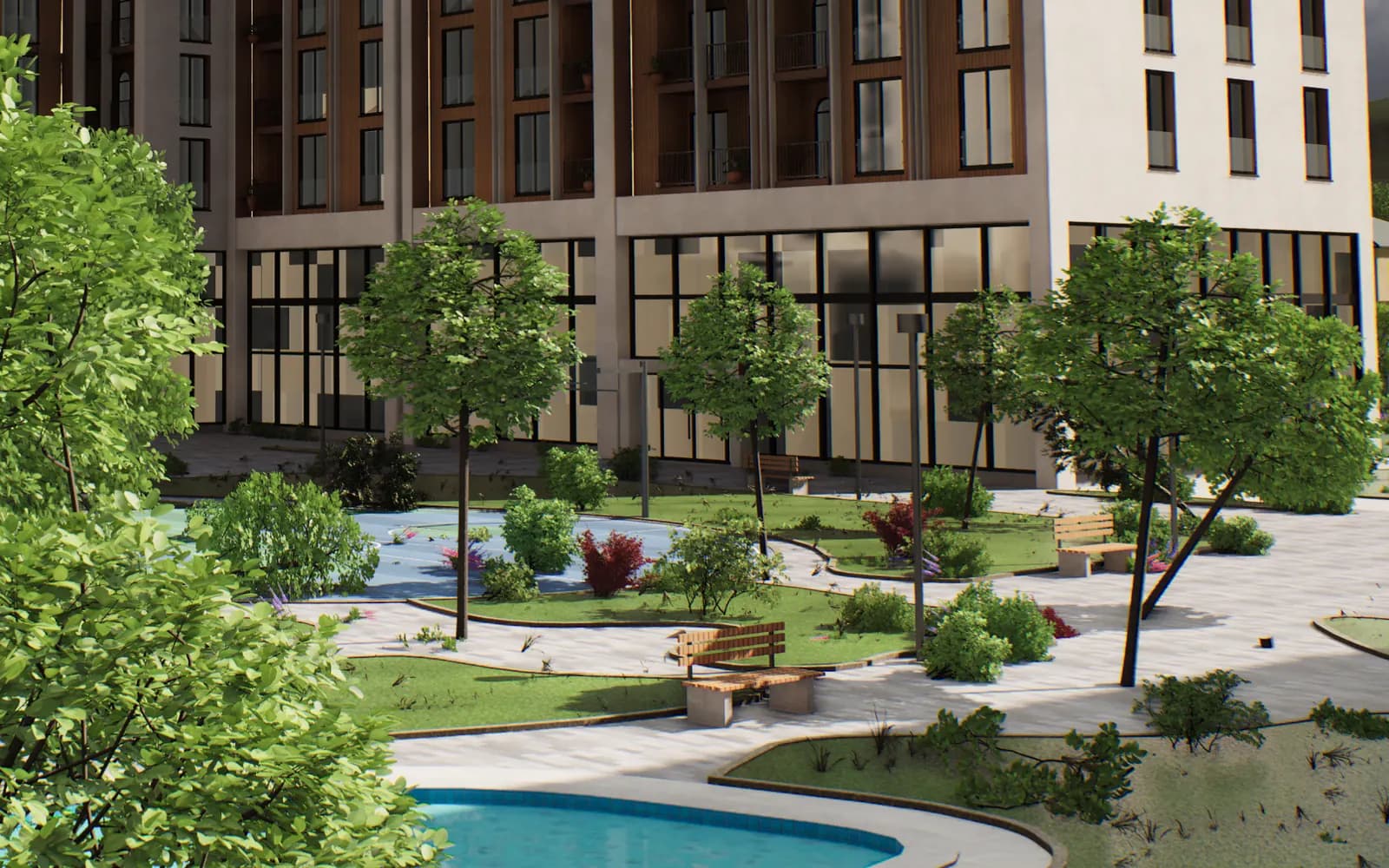
In an ad for a building under construction, the render shows the buyer something that does not exist yet, and the buyer reads it as a promise. So the render has to show what is in the project: the real view, the trees that will be planted by handover, the site's real sun and the areas in the contract. Labelling renders as visualisations, showing construction progress next to them and using one model in every channel protects the buyer's trust.
In short:
- An off-plan buyer has no building. They have a render, the sales manager's word and a contract, and they will check every detail of the render on handover day.
- The view, the neighbouring buildings, the size of the trees and the sun must match the site and the project. A prettified image brings calls today and complaints on handover day.
- Under a 2025 Supreme Court ruling, a developer is liable for the accuracy of information about apartment areas. The numbers in ads must match the numbers in the contract.
- The state mortgage is issued for homes whose ownership is state-registered. Before writing "available with a mortgage" for an unfinished building, check the terms with the bank.
- When the sales office, Instagram and the website all draw on one 3D model, the channels never contradict each other.
Why do off-plan buyers distrust renders?
Someone buying a finished flat opens the door, looks out of the window and sees the state of the stairwell. Someone buying in a building under construction looks, for now, at a building site, a few pictures and the manager's word. The hardest moment in a sales office is often not the price talk. The buyer looks at the picture and quietly asks: "Will it really look like this?"
There are reasons for that doubt. Presenting the agency's results for 2025, the head of the state cadastre and registry agency put the number of buildings without documents in the country at about 400,000–500,000. Buyers read such news, hear stories from friends and approach a new developer with caution.
The legal side is not very clear to buyers either. In our research we found no separate Azerbaijani law on shared-equity construction or escrow accounts, so check the exact position for your project with a lawyer. When a buyer sees no familiar protection mechanism, they rely on the developer's name and word. The ad is the first sentence of that word, and the render is the part people remember most.
What does a buyer read as a promise in a render?
Developers often order renders for mood. Buyers look at them as documents and later compare what they saw with what was built. Use the table below as a checklist before artwork goes to print or into the ads manager.
| In the render | What the buyer thinks | Honest version |
|---|---|---|
| An open view from the window | My floor will have the same view | The view is built from the site's real coordinates and from that floor's height |
| Big, dense trees | The courtyard will be this green when I move in | The main image shows the trees at handover size; "in 5 years" is separate and labelled |
| Empty land, sea or a park around the site | There will be no buildings next door | Existing and planned neighbouring buildings stay in the model |
| Pool, playground and sports court | All this will be ready when I move in | Only facilities in the project are shown; later phases carry a date |
| Natural stone and timber on the facade | The building will be made of these materials | The material in the specification or contract |
| Warm sunshine in every image | My flat will be bright all day | The sun follows the site's real coordinates, date and time |
| Floor plan and area | This is the exact area I am buying | The numbers match the contract and the floor plan |
| No cars in the courtyard | The courtyard is pedestrian only | Parking, access roads and fire lanes appear as in the project |
Every row in the table is a question. The buyer will ask it either when they see the ad or on handover day. The first option costs the developer far less.
7 rules of honest off-plan advertising
1. Label renders as visualisations
A short note in the corner of every image and video is enough: "Visualisation. The project may be refined during construction." The note does not reduce sales. The buyer sees that the developer is not passing a picture off as a photograph and trusts the rest of what they say more. Check with your lawyer whether such a note is a legal requirement; we recommend it either way.
2. Build the view from the real site
The most common prettification is deleting the neighbouring buildings or adding sea, mountains or a park to the horizon. In a 3D model the complex sits at its own coordinates, and the surrounding streets and neighbouring buildings are part of the model. The view from the 7th floor is then really taken from the height of the 7th floor.
There is no need to invent the sun either. According to Epic Games' documentation, the Sun Position Calculator in Unreal Engine works out the sun's position from latitude, longitude, time zone, date and time. The buyer sees what a December morning will be like in a north-facing flat before buying, not after moving in.
3. Show trees at their handover size
Courtyards are usually planted with young trees, while renders show twenty-year-old canopies. The buyer notices the difference in their first summer. The right approach is two views: the main image shows the trees on handover day, and a separate, labelled image shows the courtyard "in 5 years". We cover this in detail in our article on the rules for showing courtyards and greenery in 3D.
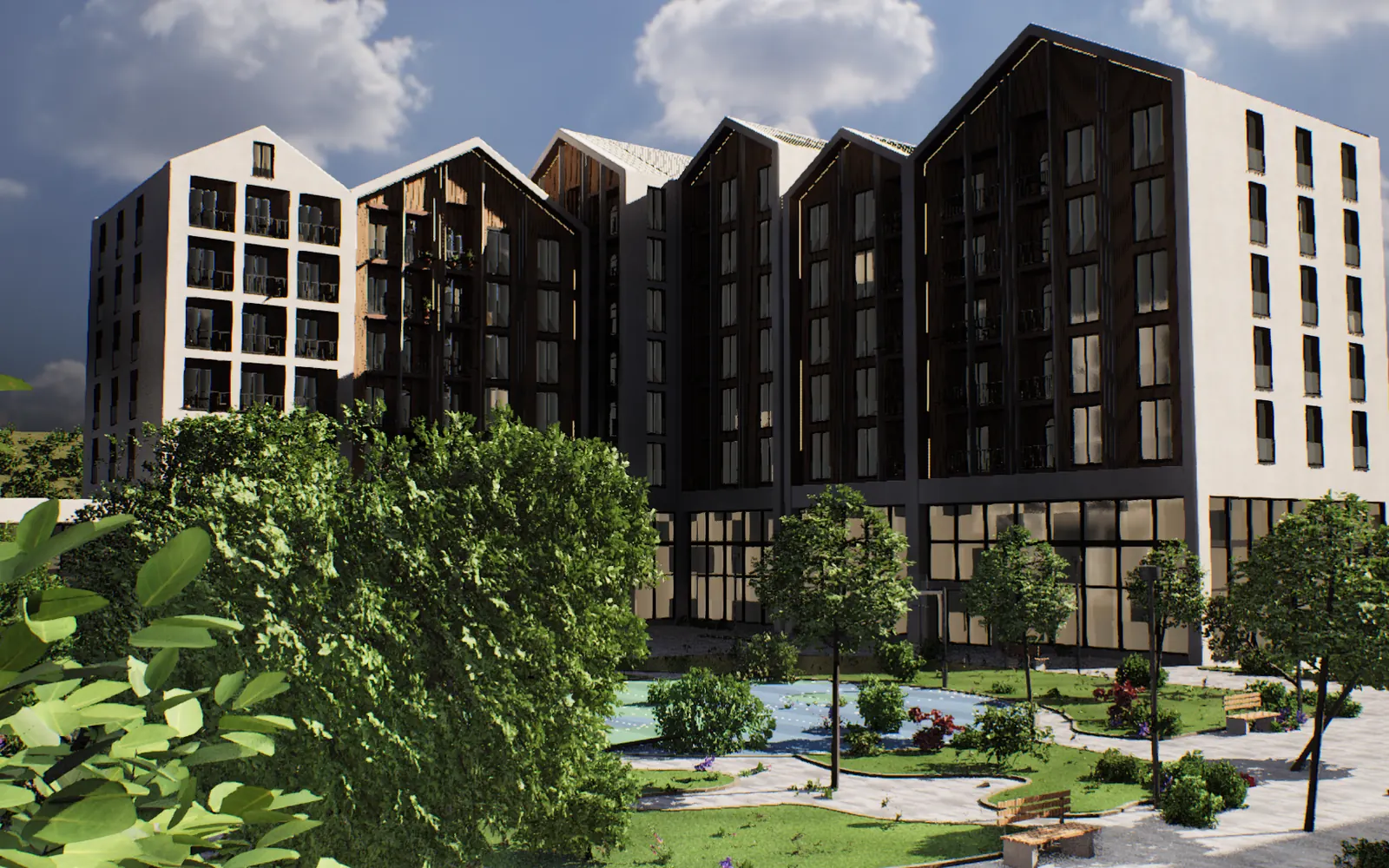
Lawns, paths and benches sit in the model exactly where the project puts them. Still from our demo project: Unreal Engine 5, real time.
4. Show only what is in the project
The pool, playground, sports court and shops in a render must be in the approved project. If a facility belongs to phase two, the image shows the phase and the planned date. If no decision has been made, leave it out of the ad: for the buyer, everything in the render is already a promise.
5. Make the numbers match the contract
The area, number of rooms and floor of a flat must be the same in the ad, on the website and in the contract. According to a Caspian Legal Center review, in a ruling of 25 February 2025 the Supreme Court held the developer liable for the accuracy of information about apartment areas. An area stated incorrectly in the contract, or later changes to the design, do not remove that liability.
Discuss with your lawyer how the ruling affects your contracts. On the marketing side the rule is simple: take the area from one source, the sales sheet, and never type it in by hand for a banner.
6. Show construction progress next to the render
A render shows the future; dated construction photos show today. When the two sit side by side, the buyer sees the promise being kept step by step. A monthly photo or short video from the same spot is enough.
Permit information builds trust too. Under the rules approved by Cabinet of Ministers Decision No. 4 of 12 January 2015, a project that receives a building permit is recorded in the State Register of Constructions and given a code, and commissioning information is posted on the register's website within 3 working days. Showing the permit number and date on your website settles many questions faster than a beautiful render.
7. Keep one picture across all channels
When one freelancer makes the Instagram renders, another studio the brochure and a third team the sales-office visuals, the facade colour, the number of trees and even the number of floors can differ. Buyers put them side by side and compare. When every channel draws on one model, there are no contradictions, and when the project changes, the fix is made in one place.
Which promises in ad copy need care?
The render is not the only thing that makes promises; the copy next to it does too. The four phrases below appear in ads often, and each one needs checking. This section is not legal advice; have your copy reviewed by a lawyer.
- "Available with a mortgage". Under the terms of the Mortgage and Credit Guarantee Fund, the loan is issued for buying a home whose ownership right is state-registered. If ownership of the flat is not yet registered, this mortgage does not apply to it. State in the ad exactly which bank lends, on what terms and from when.
- "Handover in 2027". The date must match the date in the contract. Give the quarter and year, and update the ad when the schedule moves.
- "Documents ready" or "with title deed". Write this only if it is true and you can show the buyer the document.
- "Sea view", "park view". This is true only if the view really opens from that floor and that side. In a 3D model you can check it floor by floor.
How does one model keep every channel consistent?
Keeping every channel honest one by one is hard. It is easier to take every image from one source. In a real-time 3D model the complex is built once, and then the sales-office screen, the ad video, the Instagram image and the website all come from that model. When the facade colour changes or the pool moves, the model is corrected and new stills and videos are rendered from it again.
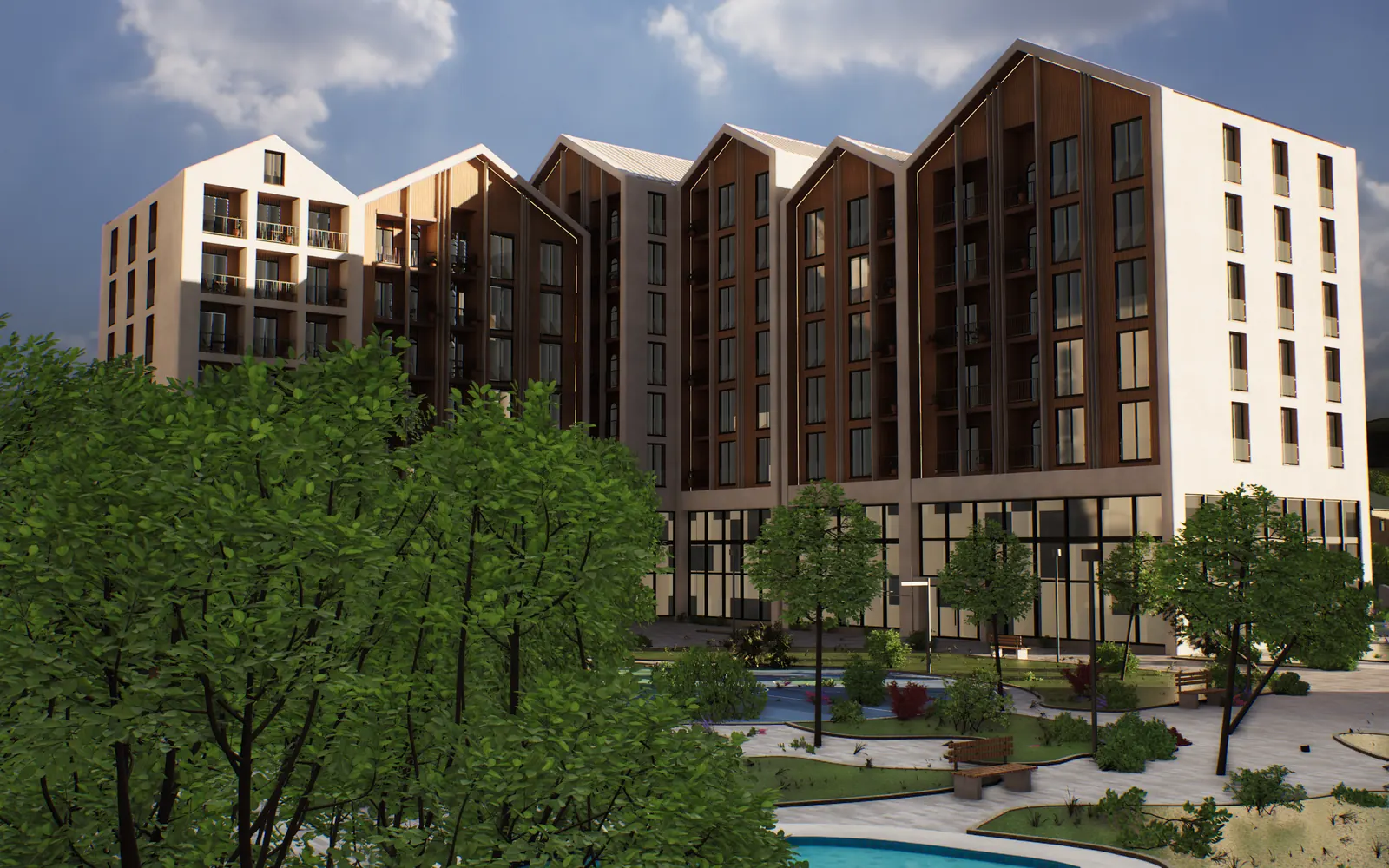
The same courtyard in the evening: the light changes, the buildings and trees stay put. Still from our demo project: Unreal Engine 5, real time.
In Baku, Advertol builds 3D Master Plans for developers in Unreal Engine 5: every building of the complex, its facade materials, courtyard, trees and surrounding streets sit in one model, and the sun follows the site's real coordinates. The sales-office touch screen, the videos and stills for Instagram and ads, and the browser version on the website all come from the same model. Apartment statuses and prices are connected to the developer's sales sheet or CRM, so a sold flat never shows as available on screen. We describe how the model is built and what materials it needs on the 3D Master Plan page.
Which visualisation format you need at which stage is covered in our guide to architectural visualisation. The sales process that answers the buyer's fears step by step is in our article on selling apartments off-plan.
In the premium segment this matters even more. There the buyer compares every touchpoint of the brand, and one mismatched image lowers the value of the whole campaign. We explain that logic in our article on premium brand marketing.
What do we look at in the meeting?
Bring your current renders, the master plan and the sales plan. In 15 minutes we look at where the renders depart from the project: views, trees, neighbouring buildings, amenity areas. Then we tell you plainly what you need. Sometimes fixing a few renders is enough; sometimes you need one model for the sales office, ads and website.
This work is not for a developer looking for two renders for a banner, or for the cheapest option. If you want every channel tied to one honest picture, book a 15-minute meeting or call +994 10 335 03 35.
Frequently asked questions
Do renders have to be labelled "visualisation"?
We did not check for a specific rule on this in our research, so confirm the legal requirement with a lawyer. From a sales point of view the answer is clear: a short note increases trust and answers the "it looked different in the picture" complaint on handover day in advance. The note can be small, but it should be on every image and video.
What size should trees be in a render?
The main image should show the trees at the size they will be planted for handover. You can also show how the courtyard will look in a few years, but in a separate image labelled "in 5 years". Take the sizes from the landscape architect's planting plan.
Can you advertise a mortgage for a building under construction?
Under the Mortgage and Credit Guarantee Fund's terms, this mortgage is issued for homes with a state-registered ownership right. So before writing "available with a mortgage", confirm which bank lends, on what terms and from when. If you offer your own instalment plan, do not call it a mortgage.
Is the developer liable if the flat turns out smaller than advertised?
According to a Caspian Legal Center review, in February 2025 the Supreme Court held the developer liable for the accuracy of information about apartment areas and did not accept later design changes as an excuse. Talk to a lawyer about your specific case. For marketing the rule is simple: never type the area into an ad by hand; take it from the sales sheet and the contract.
Can one 3D model serve the sales office, Instagram and the website?
Yes, and for honesty it is the most reliable route. The interactive sales-office app, the videos and stills for Instagram and the browser version for the website all come from one 3D model. When the project changes, the model is corrected once and new materials are taken from it.